
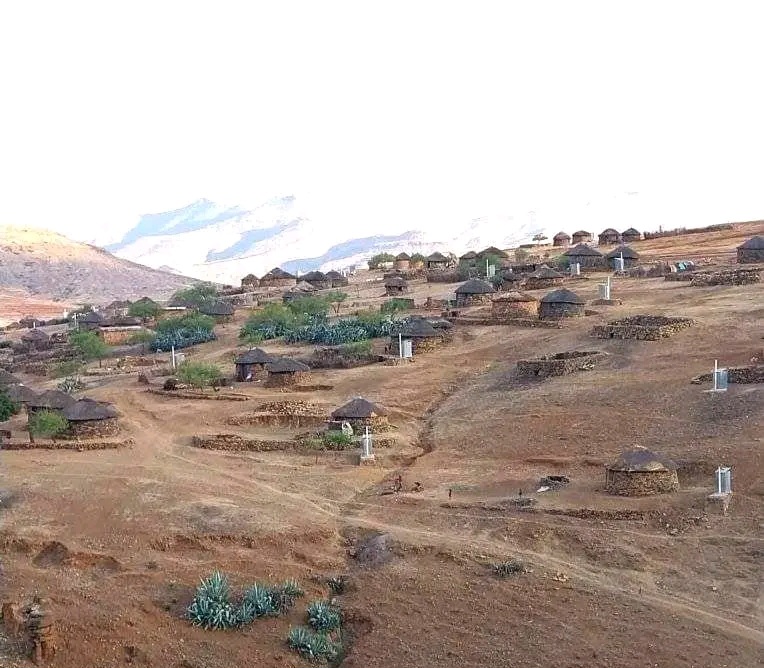
Qacha’s Nek, Jan.08 —In the remote Libobeng area of Qacha’s Nek district, residents walk long distances to access healthcare, reach government offices as the area remains without access roads linking it to nearby towns and district.
Several villages in Libobeng are isolated, forcing communities to rely on footpaths and horseback travel across steep, mountainous terrain. Residents say the situation has persisted for generations, exposing them to danger, hardship and delayed access to essential services.
Speaking to the Agency, Chief Motloang Motloang of Libobeng said four villages under his chieftainship; Ha Senarile, Ha Mosobela, Nkoeng and Mats’ekhoaneng are affected by the lack of road infrastructure.
“We need a road from Nts’upe to Libobeng and another from Thaba-Tseka to Libobeng,” said Chief Motloang.
“Horses are our only means of transport. When someone is critically ill, riding on these dangerous mountain paths puts lives at risk, and sometimes patients fall off the horse, worsening their condition.”
He said residents depend on Lebakeng Health Facility, which requires a five-hour horseback journey making timely medical attention almost impossible.
Persistent rainfall has further damaged the already poor routes used to access services.
Chief Motloang also highlighted the challenges faced during bereavement. Due to poor roads and the inaccessibility of mortuaries, the deceased are often buried the following day.
In cases where families manage to take a body to a mortuary, collecting it becomes another painful ordeal.
“When transporting a corpse on horseback, families are sometimes forced to break the knees or joints just to fit the body onto the horse,” he said. “This has been happening for a long time, and we need change.”
He added that service providers conducting outreach programmes are also affected, as they must hire horses at costs ranging from M400 to M600, making service delivery expensive and limited.
“Access roads would ease movement and improve lives,” he said.
Residents echoed these concerns.
Malefetsane Lephoi of Ha Senarile said movement from both Qacha’s Nek town and Thaba-Tseka district remains a major challenge.
“We had hope in the construction of the road from Manganeng as it is closer, but progress has slowed compared to when construction first started,” he said.
Another resident, ’Matumisang Kose from Nkoeng, described the exhausting journey to Qacha’s Nek town. “We walk the whole day from Nkoeng to Ha Senarile, sleep there, and then go to town the next day,” she said.
“When returning with heavy goods, we sleep in a shack near the river while waiting for people from home to fetch us the following day.”
She added that transport costs of M120 to town and another M120 to return are unaffordable for most families. “We wish to have basic services closer to us,” she said, adding that the road from Manganeng would also connect them more easily to Thaba-Tseka, which is nearer.
For the people of Libobeng, the absence of roads affects every part of life: health, dignity, education and economic opportunity.
As residents continue to walk for nearly everything they need, they say access roads are not a luxury, but a necessity that would finally connect their villages to services, safety and development.
Ends/MM/BM
