

This aerial drone photo taken on July7, 2025, shows the construction site of the Tunnel Boring Machine Access Adit for Polihali Transfer Tunnel in Mokhotlong district.
The Polihali Transfer Tunnel is the second phase of the multi-phased Lesotho Highlands Water Project. The project has improved local infrastructure, provided employment, and passed on essential vocational skills.
Maseru, July.14—As night falls over the northern highlands of Lesotho in early July, winter’s chill sets in. Yet the Polihali Transfer Tunnel construction site remains a hive of activity.
“We have deployed roubd the clock operations with three rotating shifts,” said Julius Topo, Site Manager for the tunnel excavation.
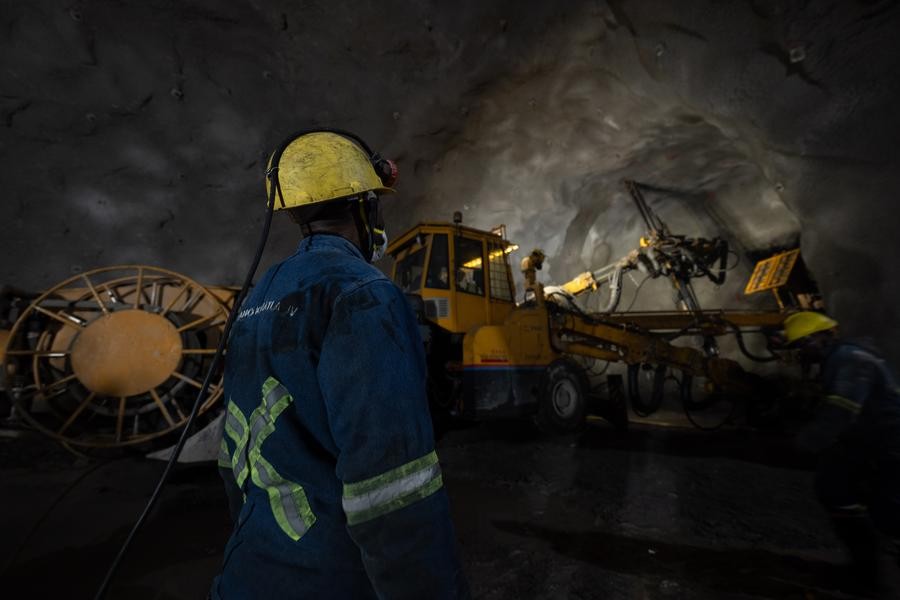
A worker monitors the operation of a rock drilling rig at the Tunnel Boring Machine (TBM) Access Adit construction site, in Mokhotlong District.
The Polihali Transfer Tunnel is the second phase of the multi-phased Lesotho Highlands Water Project (LHWP) intended to supply water from Lesotho to the Gauteng pA rovince and surrounding areas in South Africa, the project marks a flagship for Lesotho and its neighbour.
The 38-km tunnel will be excavated using two hard-rock shielded Tunnel Boring Machines (TBM), operating simultaneously from Polihali and Katse.

Guest cut the ribbon during the Tunnel Boring Machine (TBN) Arrival Ceremony at the Caledonspoort Border Post in Butha Buthe District.
The first TBM began boring from the Katse site earlier this year. On July 5, a launch ceremony was held for the second TBM at the Caledonspoort Border Post in Butha-Buthe, Lesotho.
This China-manufactured machine was shipped to Durban Port and will be assembled at the Polihali site. It is expected to significantly speed up the excavation process to meet the slated 2028 completion date.
Speaking at the ceremony, South Africa’s High Commissioner to Lesotho Constance Seoposengwe said she believed the new machine would give further impetus to the already ongoing work on the project.
“The Lesotho Highlands Water Project is more than just a water project. Local jobs have been created, and new roads have been built in the Kingdom”, she said.
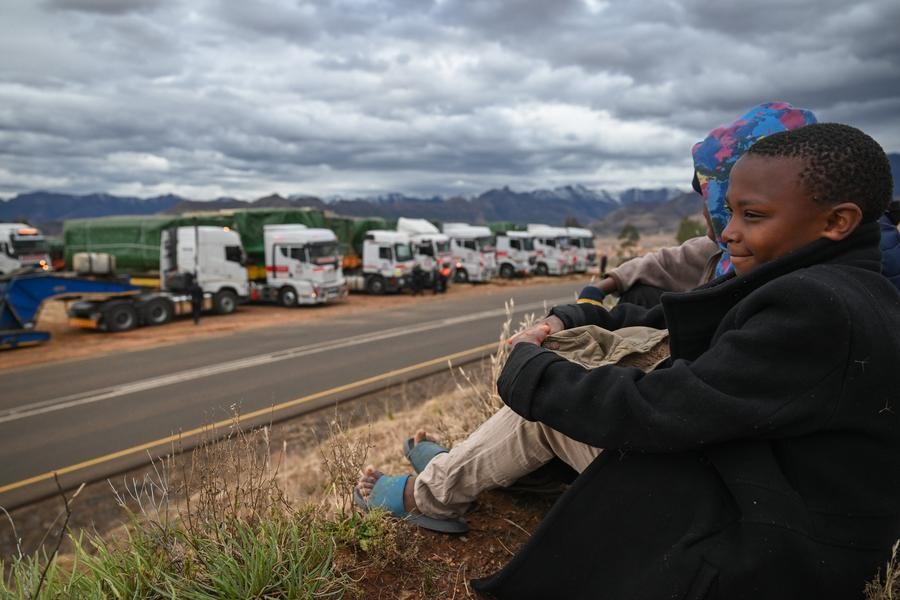
Lesotho children watch a convoy of trucks transporting components of a China-manufactured hard-rock shielded tunnel boring machince (TBM) on a hillside near Pitseng, in Leribe District.
Constructed by Kopano Ke Matla (KKM), a joint venture between China’s Yellow River Company, Sinohydro Bureau 3, and South Africa’s Unik Civil Engineering, the tunnel is the largest ongoing infrastructure project between the two countries.
Its very name, KKM, meaning “unity is strength” in the Sesotho language, reflects the diversity and inclusiveness of the workforce.
Topo, a veteran of the LHWP’s first phase in the 1990s, underpinned the importance of passing on experience. “TBMs were used in Phase I, but 30 years have passed. Now it is time for me to share my knowledge with local colleagues to enhance site organization,” he said.
“Managing a multicultural team has many challenges, but I am learning from the Chinese and sharing what I know. We are getting along,” he added.
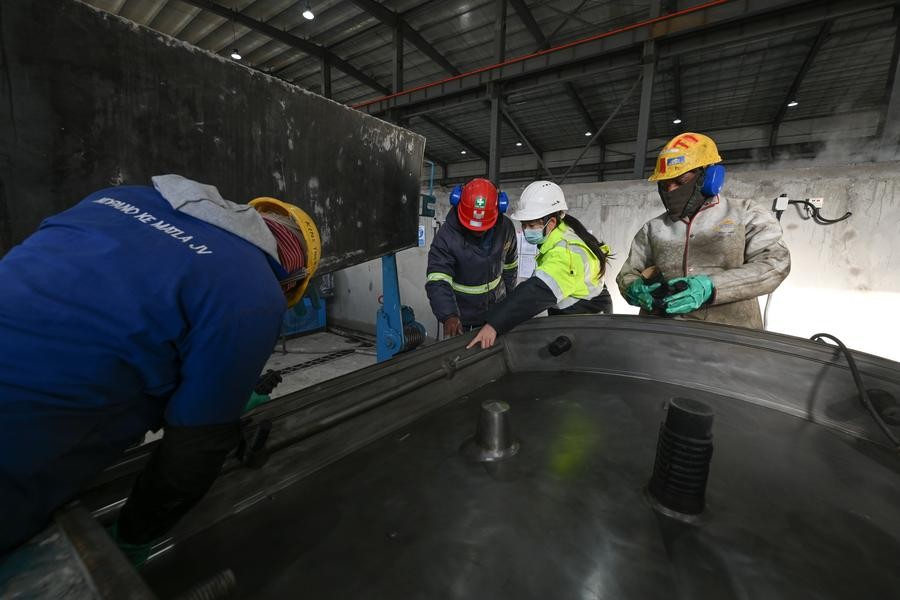
Liu Xiaolan (2nd R), a civil engineer of the Kopano Ke Matla Joint Venture, speaks with workers at the Segment Factory of the Polihali Transfer Tunnel Project, in Mokhotlong District. Polihali Transfer Tunnel is part of Phase II of the multi-phased Lesotho Highlands Water Project (LHWP).
On the other hand, Area Chief of Tloha Re Bue, one of the villages near the Polihali site, Chief Masiphola Sekonyela, praised the project’s contributions. “When I heard the Chinese would lead this project, I was excited. They work hard and know how to get the job done,” he said.
“Our people rely on farming and herding, but now they have jobs, better access to goods, and more options for the future.”
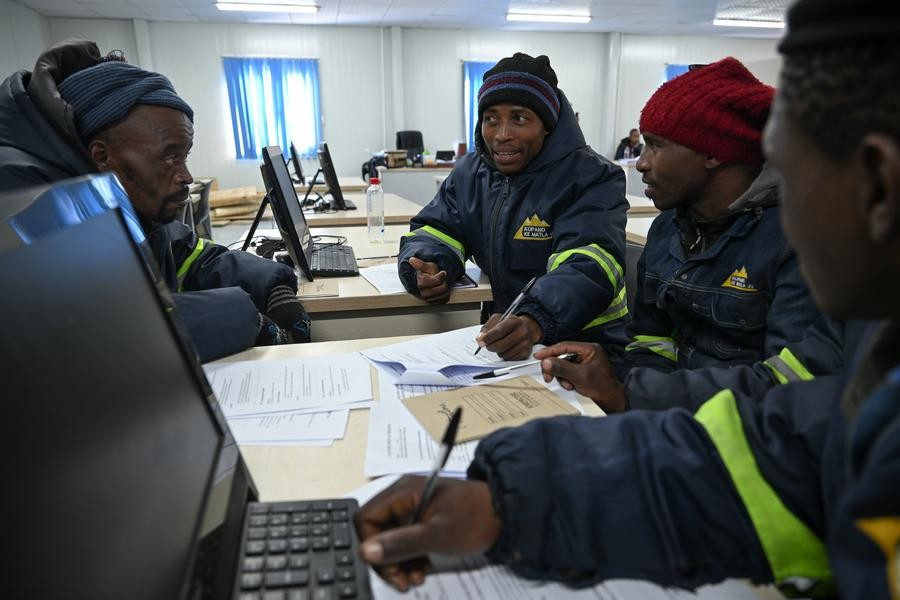
Workers of the Kopano Ke Matla Joint Venture take part in a training session at the Skills Training Center for the Polihali Transfer Tunnel Project, in Mokhotlong District.
Moreover, Chief Executive Officer of Tashie Training and Business Solutions Pride Mudzingwa, is overseeing the vocational training effort for KKM. “We have categorized participants as unskilled, semi-skilled and skilled so we can tailor classes accordingly,” Mudzingwa said.
Class sizes have been reduced from 20-25 people to 10-15 for better outcomes. Courses range from five-day workshops to three-year programs and cover plumbing, fixing, quality assurance, and more.
With an investment of more than M44 million (2.47 million U.S. dollars), the program aims to train more than 6,000 skilled workers over three years. So far, more than 500 have completed training and returned to work.
“We issue certificates recognized across Southern African countries, which means workers can stay employed or even be promoted after the project ends,” said Rethabile Letsoalo, Community/Client Liaison Officer of Tashie Training and Business Solutions.
“This could be a once-in-a-lifetime opportunity for many, and we are grateful that our Chinese partners are giving it for free,” Letsoalo said.
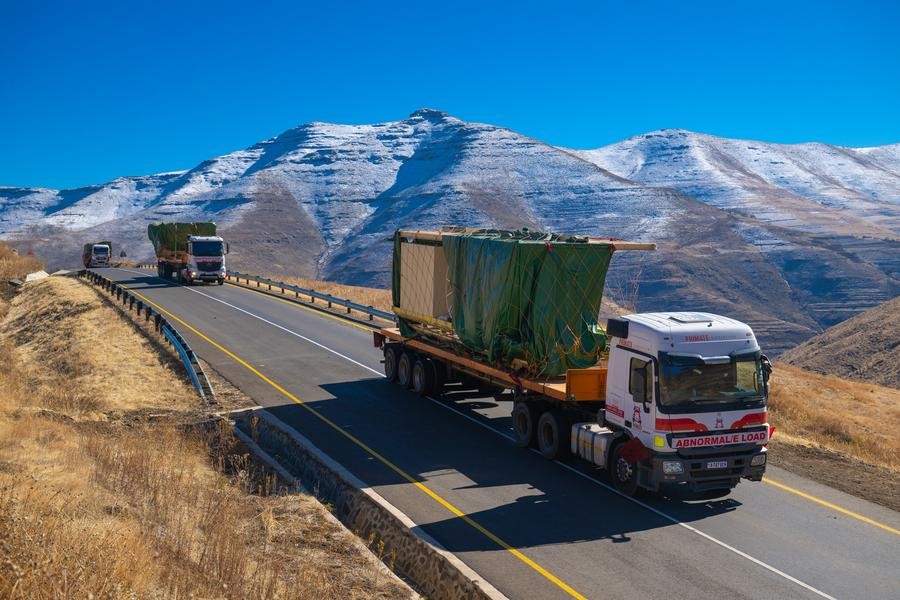
Trucks transport components of a China-manufactured hard-rock shielded tunnel boring machine (TBM) along a mountain road in Thaba-Tseka District.
Furthermore for Mpoi Rankhethoa, a translator at the Katse site who graduated last year from the Central University of Finance and Economics in China on a full scholarship, returning home to work on this project has been eye-opening.
“We rarely have a project of this scale in Lesotho, and it truly means a lot,” Rankhethoa said. “It is not the first time China and Lesotho have worked together, and it certainly won’t be the last.”
Polihali Dam is the third dam under the Phase II of the series of dams of the proposed Lesotho Highlands Water Project (LHWP) which will eventually include five large dams in remote rural areas of Lesotho and South Africa.
The Polihali Transfer Tunnel links this dam to Katse Dam, the focal point of LWHP and spans a length of 38 km with a nominal bore of five metres.
This tunnel will convey water via gravity from the Polihali reservoir to the Katse reservoir, from Katse reservoir then conveyed to Phase I’s ‘Muela Hydropower station and subsequently directed to the river enroute to Gauteng, South Africa.
Ends / AT
Source: Xinhua
