
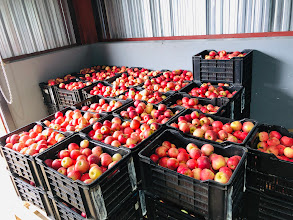
Leribe, Feb. 11 — Lesotho Horticultural Incubation and Training Centre has successfully produced apples locally, marking a significant step towards strengthening horticulture skills and boosting agricultural production in the country.
The achievement reflects progress under the Competitiveness and Financial Inclusion (CAFI) project, which is promoting the commercialisation of fruits production as part of Lesotho’s strategy to diversify economy.
CAFI Managing Director, Mr. Chaba Mokuku described the development as a milestone, noting that the National University of Lesotho (NUL) remains a key partner contributing expertise in training and research.
“This achievement shows that Lesotho has the potential to compete in high-value horticulture production,” he said.
Mr. Mokuku highlighted continued collaboration with international partners, including the United Nations Conference on Trade and Development (UNCTAD), which is supporting the establishment of a single window for business facilitation to reduce the cost and time of doing business in Lesotho.
Support from the United Nations Development Programme (UNDP) was also acknowledged.
UNDP administered M17.1 million IBSA grant from the United Nations Office for South-South Cooperation (UNOSSC), funding farmer training, ICT equipment, seedlings and a modern sorting and packing machine. The World Bank has further allocated more than M100 million towards the horticulture sub-component.
According to Mr. Mokuku, Lesotho’s deciduous fruit sector has evolved from small pilot initiatives launched in 2006 into a growing commercial industry.
Pilot orchards in Berea and Leribe districts paved the way for the establishment of larger commercial farms, all of which are now GLOBAL G.A.P certified, enabling access to export markets.
He noted that Lesotho holds a competitive advantage, as its fruits mature two to three weeks earlier due to high-altitude microclimates, fertile soils and reliable mountain water.
Since the launch of CAFI in April 2023, the number of commercial farms has increased from three to 10.
A packhouse equipped with a modern sorting and packing machine has also been established to improve post-harvest handling and market readiness.
The project has already delivered socio-economic benefits such as improved household incomes, better nutrition, employment creation and support for school fees. Local transport operators and input suppliers are also benefiting from increased production.
The initiative has been recognised as one of His Majesty’s flagship projects, underlining its national importance.
Ms. Mariana du Preez, Central Director of the Lesotho Horticultural Incubation and Training Centre, said the Centre is central to building farmers’ technical and business capacity to ensure long-term sustainability of the sector.
“We are equipping farmers with technical skills, business knowledge and modern production methods so they can compete in both local and export markets,” she said.
The Centre, established in partnership with NUL and the Ministry of Agriculture, Food Security and Nutrition, provides research support, extension services, e-learning and short courses focused on high-value crops.
So far, 190 farmers have benefited from pre-incubation programmes, while nine farmers’ companies are undergoing full incubation.
Ms. du Preez noted that strengthening farmers’ skills in orchard management, post-harvest handling and business planning is essential for improving productivity and access to finance.
Looking ahead, CAFI plans to expand from the current 10 commercial farms to at least 15 more by June 2028, while developing the full horticulture value chain, including nurseries, production, processing, packaging, transport and retail. Agricultural tourism is also being explored as a complementary opportunity.
The initiative is expected to position Lesotho as a leading exporter of early ripening deciduous fruits in the Southern Hemisphere while contributing to employment creation and rural economic development.
ENDS/MOM/tl
