
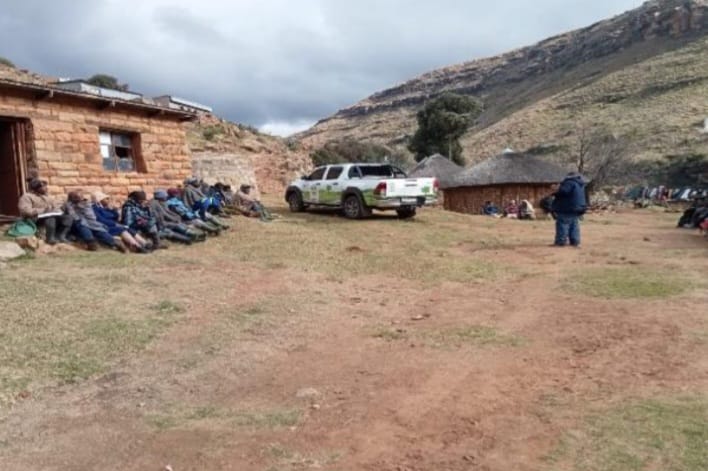
Quthing, July 28 — The Range Technical Officer from the District Department of Forestry and Environment, Ms. Likano Poeea, says the recurring challenge of rangeland burning in mountains and hills during this season is expected to become a thing of the past under the Integrated Watershed Management for Improved Agro-Pastoral Livelihoods project in the Sebapala sub-catchment.
She explained that this expectation stems from a series of training sessions held for resource user groups from different villages, equipping participants with fire prevention and management skills to safeguard their communities.
She said rangeland fires are often accidental and unnoticed at first, spread rapidly, destroying ranges and damaging natural resources, kill wildlife, destroy habitats, contribute to carbon emissions, pollute the air, degrade soil structure, and lead to severe land degradation, hence there is need for prevention and management burning pastures.
She further said Lesotho’s rangelands are vital for livestock production and clean water supply, including production of wool and mohair exports, which rely heavily on healthy grazing systems. However, uncontrolled fires continue to accelerate rangeland degradation.
Decentralization Officer from Ministry of Local Government Mr. Aupa Moorosi highlighted that there are bylaws drafted for the Sebapala sub-catchment by the ministry to help communities equitably utilize rangelands and sustainably harvest their products.
He noted that through the bylaws, accountability for environmental damage will be strengthened, and conflicts over utilization of rangeland and water sources will be reduced as accountability for environmental damage will be improved.
Lt/sgt. Lefalamang Nkoja from Mount Moorosi Police Station reminded attendees that police are tasked with protecting developmental infrastructure and land improvements.
He urged communities to protect land rehabilitation works, stressing that sustainable rangeland management directly supports healthier livestock and higher quality wool and mohair. He warned that trespassing livestock on rehabilitated rangelands remains a criminal offense and emphasized adherence to scheduled livestock transport hours.
Participants in the training included representatives of herd-boys, water committees, and members of range management associations.
The training covered villages including Tsatsane, Bolahla, Letlapeng, Tosing, Mpapa, and Dalewe. Burning of rangelands is common from June to August.
Integrated Watershed Management for Improved Agro-pastural Livelihoods in Sebapala Sub-catchment project is implemented by the Ministry of Environment and Forestry (formerly the Ministry of Forestry, Range and Soil Conservation) with support from the United Nations Development Programme (UNDP) and the Global Environment Facility (GEF)
Ends/NS/tl
