
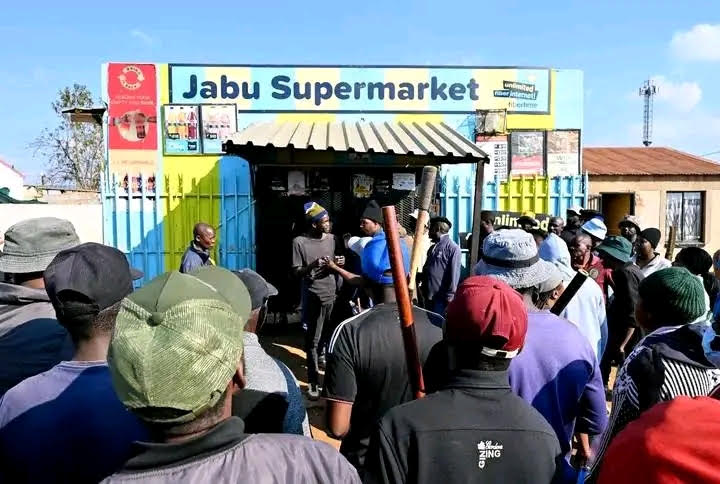
Maseru, Aug. 03 — The Migrant Workers Association of Lesotho (MWA-Ls) has called on the South African government to uphold the rule of law and ensure the safety of migrant traders amid ongoing violence and looting in parts of the country.
In a statement issued on Monday, the association expressed deep concern over marches and mob actions in several provinces, particularly Gauteng and KwaZulu-Natal.
It warned that what began as demonstrations under the banner of restoring the rule of law has, in some areas, degenerated into criminality targeting migrant-owned businesses.
Speaking with the Agency, the Executive Director of Migrant Workers Association of Lesotho Mr. Lerato Nkhets’e said Basotho are among those affected, particularly street vendors and owners of spaza shops operating in Gauteng townships.
“We are deeply concerned by what is happening in South Africa. What started as marches claiming to restore the rule of law has, in many places, turned into criminal acts.
People are breaking into shops, destroying property and looting businesses belonging to migrants,” Mr. Nkhets’e said.
Although he does not yet have verified national figures, Mr. Nkhets’e said he has already received more than 20 reports from Basotho whose businesses have been looted or destroyed.
“We receive reports through different channels, so we cannot yet provide a definitive number. However, we have already documented more than 20 cases involving Basotho who have been affected,” he said.
Mr. Nkhets’e warned that the consequences extend beyond financial losses.
“When a Basotho migrant goes to work in South Africa, the expectation is that they will send money home. Those remittances make a real difference because families depend on them for food and other daily necessities. We are also approaching the summer planting season, and many households rely on that income to buy seed, fertiliser and other farming inputs. When that income is disrupted, entire families are affected,” he said.
Mr. Nkhets’e said the violence is also taking a psychological toll.
“It is extremely difficult to work hard only to wake up and find that you no longer have an income because everything you owned has been destroyed. That uncertainty has a serious psychological impact,” he said.
Mr. Nkhets’e added that the crisis is creating strain within families indicating that when families know that someone is still in South Africa but is no longer sending money, misunderstandings can arise. He said that some may think the person is simply choosing not to support the family, when in reality they have lost everything.
He further cautioned that the disruption of remittances could have wider economic implications for Lesotho stating that the money Basotho migrants send home circulates throughout the country’s economy. It supports households, sustains small businesses and contributes to economic activity. If those remittances decline because migrants are unable to earn a living, the effects will be felt across the country.
He also appealed to Basotho living and working in South Africa to remain vigilant and avoid areas affected by unrest.
Mr. Nkhets’e urged South African authorities to act decisively to restore order, protect all people regardless of nationality, and ensure that those responsible for violence and looting are held accountable.
Ends/TS/tl
