
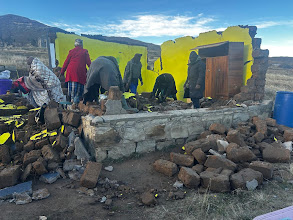
Qacha’s Nek, May 11 — Strong winds caused widespread damage in parts of Qacha’s Nek in the early hours of Monday, with Sehlabathebe among the hardest-hit areas as house walls collapsed, roofs were blown off and solar panels were destroyed.
Damage was also reported in Ha Matlali. Residents said the winds began on Saturday but intensified significantly on Sunday night, then continued into the early hours of Monday morning.
Speaking to the Agency on Monday, Ha Moshebi Chief Masoabi Mohale said more than 15 houses were damaged in Sehlabathebe, with some structures collapsing completely while others were partially destroyed.
“It is shocking to experience such powerful winds during May. This is something we have never witnessed before,” said Chief Mohale. “People are deeply disheartened because nobody expected such a disaster at this time of the year.”
He noted that the unusual weather conditions are a painful reminder of the growing impact of climate change on vulnerable communities.
According to Chief Mohale, the District Disaster Management Authority (DDMA) has already engaged local chiefs and councillors via WhatsApp to gather reports on the extent of damage across affected areas.
The destruction also severely affected Sehlabathebe National Park (SNP), where infrastructure damage raised concerns about safety and service disruptions.
SNP Culture Officer Mr. Morapeli Polokoana said the wind destroyed 11 solar panels, damaged some geysers and partially collapsed a workshop building used for daily operations.
“The situation is very worrying because the things in the damaged building are no longer safe, especially if it rains,” he explained. “Our electricity supply depends on solar energy. For now, power is still available because the batteries have already been charged, but we do not know what will happen next after several solar panels were destroyed.”
Mr. Polokoana added that workers remain fearful as strong winds continue to blow.
“We are already scared because the wind is starting again,” he said. “Usually, nearby villages are the ones mostly affected by strong winds, so it is surprising to see parts of the park suffering this level of destruction.”
Meanwhile, DDMA Disaster Manager Mrs. ’Mats’itso Motemekoane said the authority had not yet received formal reports from the affected areas, apart from photographs circulating within district communication groups.
She revealed that efforts to physically assess the damage have been hampered by a shortage of fuel.
“We are unable to verify the situation on the ground because the government garage currently does not have diesel,” she said. “The recent snowfall disrupted fuel deliveries, making it difficult for suppliers to transport diesel into the district.”
Mrs. Motemekoane added that planned Vulnerability Assessments (VA) had also been delayed due to fuel shortages.
Despite the logistical challenges, she said the DMA had proactively reached out to local chiefs and councillors through the Tsoha o iketsetse WhatsApp group to collect preliminary information. “I could not simply sit and do nothing. We need to establish what is happening in the affected communities, even though the information gathered will still need to be verified,” she said.
The latest disaster comes only months after Sehlabathebe was battered by a severe hailstorm in December 2025, which destroyed crops, injured livestock and left several communities counting heavy losses, with Mpharane identified as the worst-affected area.
The devastating winds have once again exposed the vulnerability of remote communities in Qacha’s Nek to increasingly unpredictable weather patterns. With damage assessments still underway, residents are now left to pick up the pieces and begin the recovery process.
Ends/MM/tl
