
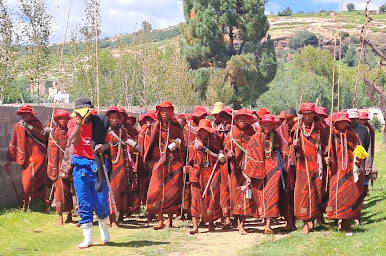
QACHA’S NEK — For centuries, lebollo, the traditional initiation of the Basotho male, has been treasured as a sacred rite of passage, a moment when boys step into manhood, dignity, and responsibility.
Deep in the mountains, the initiate is taught discipline, respect, endurance, and the values that bind Basotho identity.
But today, the same institution that once instilled pride and courage is being shadowed by reports of violence, abductions, sexual abuse and even murder. While these issues may not be new, rising global attention to human rights has placed them firmly under the spotlight.
Police records across districts point to a disturbing reality: lebollo, in some places, has changed and not for the better.
Recently, a school principal at Sebapala Primary School in Quthing, Jesse Mehlala, became a victim after he taught students about aspects of lebollo, knowledge intended to remain part of the sacred initiation process.
He was abducted for allegedly revealing traditional secrets to his students and is now suing his abductors. Mehlala, who is also a pastor and healer at Kanana St John’s Apostolic Faith Mission in Mount Moorosi recounted in High Court papers how he was assaulted during his forced initiation in October 2022 while at work.
He is suing Setipe Mohale, Selebalo Mohlomi, Mofetoli Mofetoli, Thabang Moalosi, Tšepiso Kanetsi, and Thabang Moji for M1 million in damages for pain and suffering, plus M505,000 for mental shock.
“I was abused and assaulted every day until the day I graduated from that initiation school,” Mehlala stated.
“I still have a scar on my head from the brutal beatings. Even now, I have nightmares, and hearing famo music brings back terrifying memories, leaving me anxious.”
Upon returning from the school, he required hospital care.
Other cases illustrate the extreme dangers facing initiates. Two initiation teachers, Phakiso Seleso, 34, of Qalabane, Ha-Mohlehli, and Motlatsi Khomooatsana, 22, of Tlhakoaneng in Ha-Lepolesa, were recently jailed for sexually assaulting students at schools atop the Likhoele Plateau in Mafeteng.
Meanwhile, Mosiuoa Kitime, a 28-year-old engineering graduate and the only son in his family, lost his life after trying to flee an initiation school in Mahetleng, Ha-Matela.
He was intercepted, severely battered, and later found dead.His alleged murderers, Tšepo “Sepamo” Phohleli, 34, of Ha-Nkhema in Nazareth, and 28-year-old Seabata “Khumama” Moremoholo of Bela-Bela in Berea, were remanded in custody.
In another incident, Ralimakatso Tlali, 29, from Bela-Bela, Thabang Lebusa, 40, from Lithabaneng Ha-Kepi, and Lebohang Khunong, 31, from Lekokoaneng Ha-Makoatlane, appeared before the Berea Magistrate’s Court charged with the murder of Neo Mokhethea, 39, of Lekokoaneng.
Mokhethea was found with assault marks all over his body, indicating that he had been beaten.
In 2025, three initiation school operators were charged with the murder of an initiate, Matela Matekane, who was allegedly tortured to death.
The accused; Tšolo Cheba (65) of Ha Montši, Sekhobe Masupha (36), and Moreboli Kamo (31) of Ha Letsie, on the outskirts of Maseru were remanded in custody at the Lesotho Correctional Service (LCS).
In the same year, initiator Molete Motilinyane, 75, from the Butha-Buthe district, was remanded in custody after failing to pay a M2000 bail following his arrest on allegations of sodomy against his initiates.
These cases represent just the tip of the iceberg. Together, they reveal a pattern of escalating violence that now spans multiple districts.
Many viewed the Ministry of Tourism, Sports, Arts, and Culture (MTSAC)’s 2022 Initiation School Bill, which aimed to regulate traditional initiation schools and protect participants, as a positive step.
Unfortunately, the 10th Parliament dissolved before the bill could be enacted.
In the absence of regulation, children and men continue to be vulnerable to abuse, exploitation, and violence, all under the guise of tradition, while the country awaits long-promised legal protection.
Now, MTSAC has resumed the process by holding public consultations to reassess the proposed Initiation School Bill, ensuring it aligns with the community’s current views and addresses any new concerns.
“The delay was caused by the dissolution of the 10th Parliament. We had to restart public consultations to ensure stakeholders’ views had not changed since 2022. Opinions evolve, and it was important that every stakeholder takes ownership of this Bill,” said Mrs. ‘Mamolise Falatsa, Public Relations Manager at MTSAC, in an interview with the Agency.
She explained that once enacted, the Bill will introduce legal safeguards to prevent initiates from being forced out of school. The proposed legislation specifies that only persons aged 18 and above can participate in initiation schools, protecting underage children from abuse and exploitation.
The Bill aims to protect and promote cultural values while safeguarding the rights of children and addresses several other concerns related to initiation schools.
“The Bill is still at the drafting stage following extensive public consultations. We are currently exchanging documents with the Office of the Parliamentary Counsel (OPC). After submitting public comments, the OPC reviewed the Bill and returned it to us. What remained was consulting parliamentarians and senators. Unfortunately, only senators attended our meeting on 20 November 2025. We wanted them to take ownership of the Bill before it reaches Parliament, unlike other laws they only see once tabled,” Mrs. Falatsa said.
She added, “The Bill is now back with us, and we are incorporating senators’ inputs this week. Afterwards, it will return to the OPC for review, and then our Minister will table it in Parliament.”
The Principal Chief of Kueneng and Mapoteng, Chief Peete Lesaoana Peete said introducing a law to govern initiation schools would mark a new chapter for Basotho.
“Historically, people lived in harmony, respecting one another and our culture. When someone passed away in an initiation school, they were buried there, and the family would only see the deceased’s ceremonial knobkerrie displayed on the animal hide (lekokong). Today, this tradition has been disrupted, as families now take matters to court to claim the bodies of their children for private burials, a practice that never existed before,” he explained.
He continued, “Sharing information about initiation or observing initiates while they were engaged in their duties used to signify readiness for initiation. Now, if the same happens, those involved risk legal action. This is why having a law to regulate initiation schools is essential: it will ensure our culture is respected, rather than exploited under the guise of personal rights.”
Chief Peete stressed that the law should clearly define fees for initiation, the duration of the school, and the age at which one may enroll, aligning with other legal standards.
“Basotho once followed our customs willingly. Today, we live in an era of educated individuals who prioritise written laws over traditional practices. Many dismiss our customs as outdated after being exposed to western lifestyles. Through legislation, we can ensure compliance and bridge the gaps between tradition and modern governance. Without a law, regulation becomes nearly impossible,” he said.
He further highlighted that the proposed bill aims to curb criminal activities masquerading as cultural practices. “Even if some gaps exist, the intention is sound. The law will help manage initiation schools responsibly, regulate age requirements, and prevent children from being enrolled without parental or guardian consent. Initiation should never be used as an excuse for dropping out of school.”
Chief Peete compared initiation schools to formal education, emphasizing their cultural significance. “Initiation is a cornerstone of who we are. It instills dignity, patriotism, and responsibility, preparing men to protect their families and nation. Rejecting one’s culture is never acceptable. Embracing it is an honour,” he said.
He concluded with a heartfelt appeal to all stakeholders: “Let us ensure our generation does not mark the end of our culture. By reflecting on past mistakes and correcting them, we can protect our traditions for the future. Let us remember who we are and safeguard our heritage for the generations to come.”
In contrast, the Principal Chief of Ha ’Mamathe, Chief Sempe Gabasheane Masupha, said initiation schools are already regulated under the Law of Lerotholi, whose custodians are Principal Chiefs.
“I do not support introducing a new law when one already exists. If it is outdated, those who identified the gaps should have engaged the College of Chiefs, as mandated by the Constitution, to improve it,” he said.
“What is happening now is politically influenced. If things continue this way, our culture will be tainted. The proposed law and the Law of Lerotholi cannot be mixed – it is like mixing water and oil.”
“There is no need for a new law. We must strengthen the existing one,” Chief Masupha added.
Beyond the Chiefs, other stakeholders have also weighed in on the proposed Bill, offering perspectives from initiation committees, school owners, health professionals, past initiates, parents and educators.
The Pheellong Area Initiation Committee secretary, Mr. Nthethe Letumanyane, acknowledged the difficulty of regulating initiation school owners in the absence of existing laws. He noted that some school owners have even engaged lawyers to challenge prohibitions on admitting underage initiates.
Mr. Moeketsane Tsekela, an initiation school owner and traditionalist, said he supports regulating initiation schools but disagrees with the proposed age restrictions.
“Age restriction will not work. The current generation is very rebellious; they won’t accept it, and we would spend every day sending them back home. At 15, many already look over 20. Refusing their entry based on age alone feels unfair,” he said.
“In a group of 20 initiates, only about five are usually above 18. Where will we get the rest if the law restricts them? Age shouldn’t determine eligibility. Physical fitness should. If a boy appears mature and capable, he should be allowed to participate.”
He added, “We do not support children dropping out of school for initiation. They should only attend during school holidays. We do not accept boys during formal school terms. The law can be established, but I do not agree with the age restriction.”
Speaking during public consultations in October 2024 in Qacha’s Nek, Mr. Semoko Moruri, a principal instructor from Ha Mosuoe, raised concerns about the commercialisation of initiation schools and stressed the need for stricter regulation.
“Initiation schools should remain a cultural tradition, not a business venture. We need this law to preserve that,” he said.
Traditional doctor Mr. Mzwandile Khoathi of ’Melikane echoed this sentiment, urging swift enactment of the bill to address ongoing challenges. “For this to work, school owners need proper training and support,” he said.
Healthcare professionals also weighed in. Mokone Molupe, a nurse at Machabeng Government Hospital, praised the initiative. “The bill will help ensure that all stakeholders operate within a standardized framework, benefiting both students and the broader community,” she said.
Past initiate Mr. Tumelo Lekaota said he chose to attend initiation school because, from childhood, he was taught that initiation is central to Basotho culture. “It is a rite every boy passes through when transitioning to adulthood. Initiation molded me into a better version of myself,” he said.
“During my time, the abuses being reported today never happened. The allegations are surprising and honestly frightening. I hope all stakeholders come together to restore the dignity of initiation.”
Lekaota said the situation has changed because too much power now lies with school owners and traditional doctors, while other key stakeholders such as chiefs, committees, and past initiates are often excluded. “This has completely changed the narrative, and sadly, not for the better. We need a law to govern initiation schools, protect initiates, and preserve our culture,” he added.
Another past initiate, Mr. Hlomelang Makoa, said the problem is not the absence of a law but the lack of oversight from all responsible stakeholders; school owners, doctors, instructors, and even initiates themselves. “Even if the law sets a specific age for initiation, how will it be enforced when we have abandoned the guiding principles that worked for centuries?” he asked.
“In my home village, no child was admitted without proper consent. But we abandoned our roots, and now we believe a piece of paper will solve everything,” he said, adding: “What we need is proper vetting. Anyone who wants to open an initiation school, along with everyone they work with, must be vetted to ensure they genuinely want to protect the culture.”
A young man preparing for initiation expressed mixed feelings: “I’m excited because I’ve grown up knowing this is an important step toward becoming a man in my community. But at the same time, the stories we hear today are worrying. I just hope the school I attend follows proper procedures and prioritizes our safety. My wish is to experience the same dignity and discipline our fathers and grandfathers talk about. I want to come out stronger and wiser, not traumatized.”
Not all men share the same experience. Mr. Neo Masoabi, who has never undergone initiation, said he has never had an interest because no male figures in his family participated. “So there was no inspiration for me to go. In my village, only three families, including mine, did not participate.”
He added, “The community treats us differently, labelling us stupid and claiming we’re not ‘man enough.’ Personally, it doesn’t bother me. I don’t feel excluded, and I’ve never felt pressured. Sometimes they even call me a boy (moshemane), and I still don’t mind. At one point before I turned 35, I considered going. But the risks are too high. Reports of deaths and rape make initiation schools feel unsafe. I don’t want to die. I never hated initiation before; now I do.”
He emphasized that deaths in initiation schools must be criminalized. “Justice should be served when a death is not natural. That is the only way to restore dignity and encourage more Basotho men to preserve their culture and this is possible through an Act.”
Parents also weighed in. Mr. Thabiso Nts’inyi, father of an initiate, said he supports initiation but only when done properly. “I want my son to learn discipline, respect, and the values Basotho men were raised on. But I am also afraid because too many things are going wrong in some schools. We need the law so parents can be confident their boys will return home safe. We are not against culture; we just want it protected.”
Similarly, Mrs. ’Mampho Ramarumo, mother of boys, voiced her support for regulation. “For more than a decade, we lost an initiate in our neighbourhood who was said to have died a natural death at initiation school. I had my doubts, and now the police reports confirm my fears. Hearing reports of abuse only adds to the fear. For me, initiation should be a safe space for boys to learn, not a place of abuse.”
The issue is also affecting education. An alarming 87 percent dropout rate in rural areas, compared to 13 percent in urban areas, has emerged in the Extended National Strategic Development Plan (NSDP II).
Qacha’s Nek District Education Manager, Mr. Lebenya Mothibeli, said many students are reportedly leaving school for initiation practices, especially those approaching their final examinations, raising concerns over the impact on academic outcomes. Many of the students who have abandoned studies are under 18, describing the situation as a “crisis.”
He warned that absenteeism from school severely compromises education, with some students missing examinations. “We’ve received reports from many high schools around Qacha’s Nek, with teachers noting a surge in students dropping out to attend initiation schools. If we, as Basotho, want this practice to be respected, we must agree on the appropriate age for a person to be admitted,” Mr. Mothibeli said, urging Chiefs in affected areas to help students return to school. He also highlighted that some of the students are supported through bursaries from the Ministry of Social Development.
Mr. Mothibeli called for clear timelines to regulate initiation schools and raised concerns about demarcation lines, questioning what measures are in place to address the situation.
Meanwhile, when announcing the 2025 Primary School Leaving Examination (PSLE) results on Monday, the Minister of Education and Training, Professor Ntoi Rapapa, said that of 34,842 learners registered, 34,165 sat for the exams. “The remaining 677 were absent due to reasons including initiation schools, illness, and parents or guardians losing their jobs,” he said.
According to the UNICEF Adolescent and Youth Learning in Lesotho: Situational Analysis (2023), boys in several districts report missing school for weeks during initiation periods, with some never returning to the classroom after completing lebollo. The report states that “initiation schools are repeatedly mentioned by boys as a reason for prolonged absenteeism and eventual dropout, particularly at the lower-secondary level.”
A 2010 investigation by The New Humanitarian titled “Lesotho: Boys Quit School to Become Men” similarly documented how boys as young as 13 left school to attend initiation, often during exam periods. The report found that “after returning from the mountains, many boys consider themselves men and decline to re-enroll in school,” highlighting a cultural tension that persists today.
International assessments confirm the scale of the risk. The World Bank’s Learning Poverty in Lesotho Country Brief (2022) reported that over 70 percent of 10-year-olds in Lesotho cannot read and understand a simple text, one of the highest levels in Southern Africa. The brief notes that dropout among boys during adolescence “deepens learning poverty and undermines efforts to achieve secondary-level attainment.”
Similarly, the UNESCO Institute for Statistics (UIS) SDG 4 Country Profile for Lesotho (2023) shows a steep decline in lower-secondary completion, especially among boys. The profile places Lesotho’s male lower-secondary completion at well below the regional average, citing “persistent social and cultural factors” affecting male attendance.
Comparatively, according to the UNESCO Southern Africa Education Progress Review (2022), countries like Botswana and Namibia have significantly higher lower-secondary completion rates, often above 60 percent, while Lesotho lags partly due to “context-specific cultural disruptions,” including initiation-related absenteeism.
Globally, the World Bank–UNESCO joint report State of Global Learning Poverty Update (2022) warns that countries with male dropout linked to social rites face long-term labour and skills shortages, noting that Lesotho is at heightened risk unless “cultural practices are harmonised with school safety and attendance policies.”
Without regulation including age limits, registration of initiation schools and guaranteed reintegration of initiates, Lesotho risks sliding further from its Sustainable Development Goal (SDG) 4 commitment to “ensure inclusive and equitable quality education for all.”
Mr. Lethola Mafisa, Equality and Rights for All Advisor at UNAIDS, said their research shows that men are the least likely to test for HIV, the most likely to die from it, and that many have low levels of education. He also noted that men lead in unsafe sex and multiple concurrent partnerships.
“A law could help by preventing boys from entering initiation at a very young age. If they go after completing high school, they will have more education and more information to protect themselves,” Mafisa said. “Currently, without regulation, children are being initiated too early. Many do not return to school, and some become involved in promoting child marriage, putting themselves and others at risk of HIV.”
He added that it would be wise to integrate sexual and reproductive health education into the initiation curriculum, working closely with trained nurses. As public health practitioners, Mafisa said they need a formal memorandum of understanding with initiation schools to address key issues, including ensuring that initiates on lifelong treatment continue taking their medication as prescribed.
Mr. Mafisa’s warnings highlight the urgent intersection between cultural practices and public health. With boys entering initiation at increasingly younger ages, the potential risks extend beyond education and social development to serious health outcomes, including HIV exposure and treatment disruption.
These public health concerns intersect with a longstanding cultural practice, as recent surveys show how deeply embedded initiation remains in Basotho society.
According to the 2014 Lesotho Demographic and Health Survey (LDHS), about 72.2 percent of Basotho men aged 15–59 reported being circumcised, up from 48.1 percent in 2004 and 52.0 percent in 2009. Within those circumcised in 2014, nearly half reported traditional initiation as their method.
More recently, a 2023–24 analysis based on LDHS data estimated that roughly 51 percent of adult men in Lesotho have undergone traditional male circumcision. The study also found that traditional initiation is most common among older men, men from rural areas, and those from lower-income or less-educated households, highlighting significant socio-economic variation in participation.
These figures suggest that initiation whether traditional or medical remains widespread, underscoring how deeply embedded the practice continues to be within Basotho society. The prevalence of traditional male circumcision across decades shows that it is not a relic of the past but a current reality, which helps explain why calls for regulation, safety, and legal clarity have gained urgency.
As Lesotho navigates the delicate balance between tradition and safety, lebollo stands at a crossroads. For centuries, it has shaped Basotho identity, instilling discipline, courage, and cultural pride. Yet rising cases of abuse, early initiation, school dropouts, and health risks reveal a harsh truth: without oversight, even a revered tradition can fail its own.
All stakeholders agree: lebollo is too important to lose, yet too fragile to remain unregulated. The proposed Initiation School Bill, combined with community engagement, public health education, and strict enforcement of age and safety standards, offers a chance to restore dignity, protect boys, and ensure Basotho culture thrives responsibly.
The mountains still call Basotho boys to the rite, but whether they emerge as men educated, healthy, and safe depends on how tradition and law walk this path together.
Ends
