
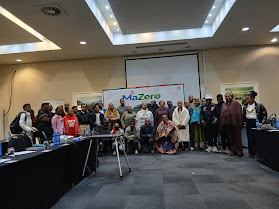
Maseru, April 24 — Stakeholders from various sectors gathered for the MaZero e-Mobility workshop, an initiative aimed at promoting sustainable transport solutions and reducing carbon emissions in Lesotho.
Speaking at the workshop, Ms. Sebabatso Ntlamelle, Health, Education and Social Development Commision Coordinator at Lesotho Council of NGO’s (LCN) described the MaZero project as an interesting and timely concept.
She noted the increasing use of petrol-driven vehicles and warned that the country continues to face serious challenges related to climate change.
Mrs. Mantopi Lebofo, Executive Director at Technologies for Economic Development (TED) explained that the workshop aims to familiarise stakeholders with the MaZero project while mapping out both individual and institutional contributions to its implementation.
She said the initiative also seeks to raise awareness about e-mobility as a key solution for decarbonising Lesotho’s transport sector and to promote collaboration towards a healthier environment in Maseru.
She emphasised that the MaZero project is being implemented by the National University of Lesotho Energy Research Centre (NUL-ERC) under the theme ‘Piloting Renewable Energy-Based e-Mobility in Maseru to Decarbonise the Transport Sector’.
She mentioned that the initiative is aimed at transforming Maseru’s transport system towards near-zero emissions through energy-driven e-mobility.
Mrs. Lebofo highlighted that the project aligns with national frameworks such as the Lesotho Transport Policy (2014) and the Nationally Determined Contributions (NDC) of 2017, which prioritise improving energy efficiency in the transport sector through appropriate policies and investments.
She noted that the first NDC also focuses on promoting fuel-efficient vehicles and improving emissions from existing vehicles through standards and capacity building.
At the same event Energy Expert from National University of Lesotho Energy Research Centre, Mr. Moruti Kao explained that e-mobility involves the use of electric vehicles to transport people and goods while minimising toxic gases and greenhouse gas emissions released into the atmosphere.
He outlined the main types of electric vehicles, including hybrid electric vehicles (HEVs), plug-in hybrid electric vehicles (PHEVs), and battery electric vehicles (BEVs).
He explained that hybrid vehicles use both petrol and electricity without external charging, while plug-in hybrid vehicles can be charged, and battery electric vehicles rely entirely on electric power.
Mr. Kao said key components of electric vehicles, including the battery, charge port and DC converter.
He said the battery supplies power to the vehicle, the charge port connects it to an external power source for charging, and the DC converter transforms high-voltage power into lower voltage for use by the vehicle’s systems.
In addition, he highlighted different charging technologies, noting that they are broadly classified into wired and wireless systems.
Charging stations, he added, range from slow and semi-rapid to rapid and ultra-fast charging.
The workshop emphasised the importance of transitioning to cleaner transport systems, with stakeholders expressing optimism that the MaZero initiative will play a significant role in reducing emissions and promoting sustainable mobility in Maseru.
Ends/MAMAJ/tl
