
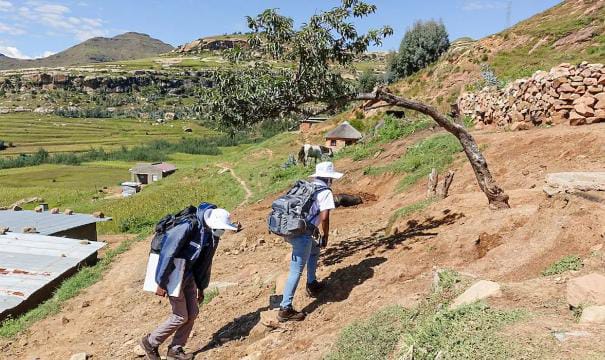
Maseru — Deep in the highlands of Lesotho, where winding mountain paths link scattered villages, small clinics stand as beacons of hope for isolated communities. Health workers, armed with cooler boxes and determination, travel long distances to ensure that every child receives the life-saving measles and rubella vaccines. Their mission is simple yet ambitious, to make Lesotho a nation free from these preventable diseases.
In the month of October, Lesotho is conducting a nationwide measles-rubella vaccination campaign targeting children aged 9 to 59 months. The campaign launch event occurred mid-October, followed by intensive preparation through training and community-mobilisation.
The objective is to protect children from measles and rubella, close immunity gaps, and contribute to elimination goals. The effort integrates other child-health interventions and mobilises multiple partners. Success will depend on reaching high coverage and ensuring follow-up access to routine immunisation.
As this campaign continues across the country, health workers say true success would mean more than just empty hospital wards. It would mean zero new cases of measles and rubella for at least three consecutive years, which is the World Health Organization’s benchmark for elimination. It would also mean that every child, from the streets of Maseru to the remotest corners of Mokhotlong, is protected through timely vaccination.
At the Mahobong Filter Clinic, nurse and midwife Sister Ntoetsi Nts’ekhe balances her daily duties while mothers line up with their children. Between comforting crying babies and preparing syringes, she shares her thoughts on the national vaccination drive.
“Eradicating measles and rubella would not only save lives but also transform families be when children are healthy, families thrive and the entire nation benefits,” she said.
She adds that protecting children is not only the mother’s duty but a shared community effort involving fathers, grandparents, neighbours and chiefs. She also recalled the Sesotho proverb ‘Lehlanya lea bokaneloa’, meaning a community shares responsibility, even for one person’s wellbeing.
The fight against rubella and measles goes far beyond needles and syringes. It is built on trust between parents and health workers, confidence in the safety of vaccines as well as an understanding that prevention is better than cure. It depends on strong surveillance systems that ensure every suspected case is swiftly reported, tested, and contained before it spreads further.
For ’Masechaba Mohlomi of Mohope in Mahobong, whose daughter recently received her second dose of the measles-rubella vaccine, the campaign brings peace of mind.
“I no longer worry about my child falling sick from these diseases and this initiative to show that the health system cares,” she says with a smile.
At the community level, traditional leaders are playing a vital role in mobilizing parents and guardians. Chief Khethisa Tau of Pitseng emphasizes that protecting children through vaccination is both a cultural and moral duty.
“As Basotho, we must protect the future of our children. These vaccines are shields that keep our communities safe. When one child is protected, the whole village is protected,” he says.
The Chief mentioned that the nation has witnessed how diseases can spread quickly, but with vaccination, outbreaks can be prevented and save lives urging Basotho to stand together, just as the forefathers did, to keep the people healthy and strong.
Religious leaders across the country have also thrown their support behind the campaign. The Christian Council of Lesotho (CCL) and other faith-based organizations have partnered with the Ministry of Health, encouraging their congregations to participate.
They stress that vaccination is not only a medical responsibility but also a moral and spiritual act of love and protection. Their involvement has helped counter vaccine hesitancy in some areas and strengthen community confidence in the health system.
Lesotho has made remarkable progress in expanding immunization coverage, reaching thousands of children who might otherwise have missed out. However, sustaining 95 percent vaccine coverage, the threshold required to achieve herd immunity, remains a challenge due to the country’s mountainous terrain, limited resources and pockets of hesitancy.
The country introduced the combined measles-rubella vaccine in February 2017, replacing the single-antigen measles vaccine under the Expanded Programme on Immunisation (EPI), guided by the World Health Organization. To reach children who miss routine doses, the Ministry of Health organizes Supplementary Immunisation Activities, which help close immunity gaps.
According to reports from WHO Regional Office for Africa, during Africa Vaccination Week in July 2023, more than 20,000 children aged 9 to 59 months were vaccinated nationwide.
Integrated campaigns in 2022 and 2023 combined measles-rubella vaccination with polio immunization, deworming, and vitamin A supplementation, boosting both immunity and nutrition.
The momentum has continued into 2025, with the Ministry of Health launching a nationwide measles-rubella campaign in October targeting nearly 200,000 children aged 0 to 59 months.
Supported by WHO, UNICEF, and GAVI, the campaign ran from October 20 to 24, with mop-up activities from the 25th to 27th.
In Qacha’s Nek, reports revealed that vaccination teams began in preschools and village centres, while outreach workers scaled the mountains to reach children in remote communities while in Mokhotlong, early community engagement led to strong turnout and trust between residents and health workers.
The success of these efforts reflects the power of partnership between government institutions, local leaders, faith communities, international partners, and parents themselves.
Together, they are building a healthier, more resilient Lesotho, one child at a time.
Lesotho’s vaccination drive embodies the spirit of the Sustainable Development Goals. It advances Goal 3, ensuring good health and well-being for all, Goal 10, reducing inequalities by bringing healthcare to remote communities and Goal 17, strengthening partnerships for sustainable progress. The ultimate reward will be a generation of children growing up without the threat of measles or rubella which is a testament to Lesotho’s unity, resilience and commitment to equity in health.
As the country continues this journey, the vision remains clear, a future where no parent fears losing a child to a preventable disease and where Lesotho stands as a proud example of health, strength and hope in Africa.
Ends/NT/ml
